7 AI Lessons for FinOps Teams: Lessons for Proactive Vendor Cost Management
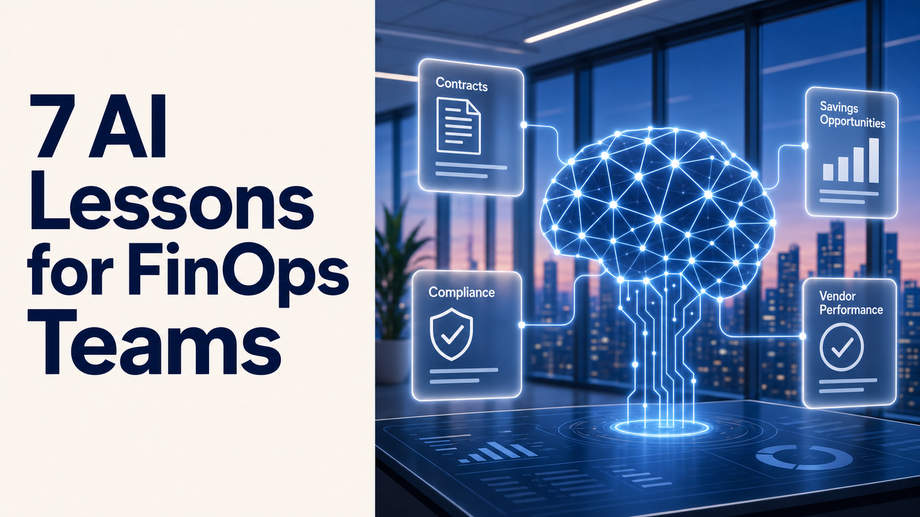
AI adoption in corporate finance has moved past the pilot-program phase. According to KPMG's research, more than three-quarters of organizations are already piloting or using AI for accounting and financial planning, and over 60% are doing the same for treasury, risk management, and tax operations. The report's framing is blunt: the question for finance leaders isn't whether to implement AI, it's how fast to scale it.
That framing applies directly to one of the most AI-ready problems in finance: vendor and contract cost management. Most FinOps teams still treat vendor oversight as a manual, reactive exercise — someone checks a spreadsheet before a renewal, someone else searches an inbox for a contract PDF. KPMG's seven tips for finance AI map cleanly onto what proactive, AI-assisted vendor intelligence actually looks like in practice. Here's how each one translates.
1. Quality Control Becomes Contract Data Accuracy
KPMG's first tip is improving the quality and speed of financial analysis through use cases like data entry automation, fraud detection, and predictive analytics. In vendor cost management, the equivalent is contract data quality: renewal dates, pricing tiers, and usage figures that are automatically extracted and kept current, instead of manually re-entered from a PDF every time someone remembers to check. Bad contract data produces the same downstream damage as bad financial data — wrong forecasts, missed deadlines, budget surprises that show up too late to fix.
2. Plan Ahead Means Treating Vendor AI as a Real Roadmap Item
A well-thought-out AI implementation plan, per KPMG, means actively testing and refining use cases rather than bolting on AI as an afterthought. For FinOps, that means deciding early which vendor workflows should be automated — renewal alerting, pricing-change detection, usage monitoring — rather than discovering a year from now that the team is still doing all three by hand while the rest of finance has moved on.
3. Think Outside Accounting — Vendor Costs Touch Every Function
KPMG explicitly warns against limiting AI to accounting and reporting, pointing instead to financial planning, treasury, tax, and risk management. Vendor cost management has the same blind spot risk. Contract renewals affect procurement, IT owns the tooling, finance owns the budget line, and legal owns the terms — but if AI-assisted tracking only lives in one team's spreadsheet, the other three are still flying blind on the same contracts.
4. Ask for Help — Vendor Intelligence Doesn't Have to Be Built In-House
Not every finance team has AI specialists on staff, and KPMG's advice to draw on outside expertise applies just as well to vendor management. Purpose-built platforms that already do automated vendor research, pricing benchmarking, and renewal tracking remove the need to build that capability from scratch — the same logic as pulling in an AI specialist rather than reinventing the function internally.
5. Be Proactive — Governance Applies to Vendor Data Too
KPMG's call to establish AI guidelines and governance early is really a call against waiting until something breaks. In vendor management, "being proactive" means alerts fire 90, 60, and 30 days before a cancellation window — not the week after it closes — and that contract ownership is assigned before a renewal is urgent, not during the scramble.
6. Be Alert to Blind Spots — Transparency Cuts Both Ways
KPMG flags transparency as a common blind spot in AI-driven finance: if nobody understands how an algorithm reached a conclusion, trust erodes fast. The same principle applies to vendor intelligence tools. Alerts and pricing-change flags are only useful if the underlying contract data — the actual renewal terms, the actual usage numbers — is visible and auditable, not a black box the team has to take on faith.
7. Find a Teammate — FinOps and IT Need the Same Shared View
KPMG's final tip is about finance and auditors working in tandem, each with visibility into how the other uses AI. FinOps and IT need the same relationship around vendor tools: procurement negotiating a renewal and the engineering team actually using the product need to be looking at the same usage and cost data, not reconciling two different spreadsheets after the fact.
Turning These Lessons Into a System
KPMG's report is aimed at finance broadly, but the underlying pattern — automate the data collection, keep humans focused on judgment calls, act before deadlines instead of after — is exactly what Asozal was built to operationalize for vendor and contract cost management specifically. Automated vendor research, renewal alerts tied to actual notice windows, and centralized contract data replace the manual spreadsheet-and-inbox approach most FinOps teams are still running.
If you want to see how this works end to end, Asozal's documentation covers the vendor intelligence and alerting features in detail, the pricing page breaks down what's included at each plan tier, and the FAQ answers common questions on setup and data import for teams moving off spreadsheets.
AI is already reshaping how finance teams work, according to KPMG's own data. Vendor and contract cost management is one of the clearest places to apply it. Start free with 10 vendor records and see what proactive, automated vendor tracking looks like against your own contract portfolio.