Agentic FinOps Without the Risk: A Bounded Starting Point for Vendor Cost Management
Agentic FinOps Without the Risk: A Bounded Starting Point for Vendor Cost Management
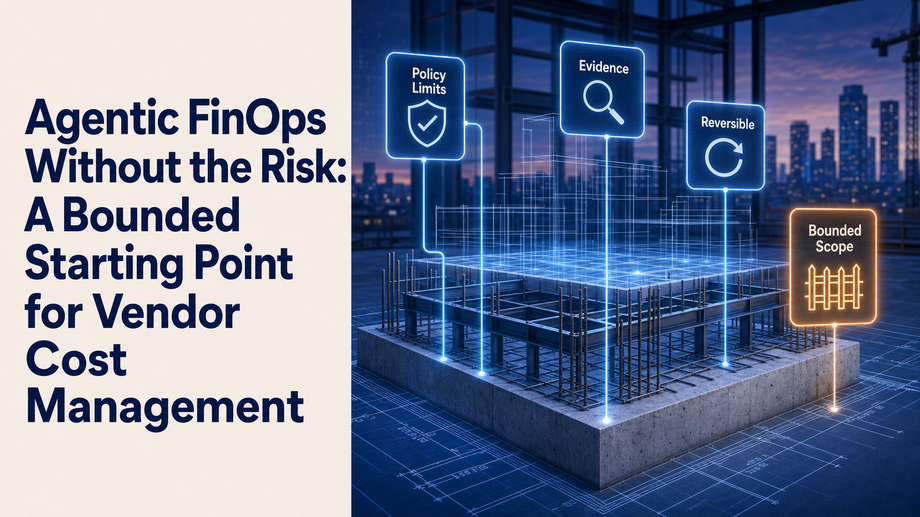
The FinOps Foundation's recent analysis of agentic FinOps adoption lands on an uncomfortable truth: most practitioners haven't adopted AI agents yet, and the reasons aren't technical hesitation — they're structural. An agent becomes more useful as it gains organizational context and authority, and harder to trust and govern for exactly the same reason. The Foundation's guidance for closing that gap is consistent: start with narrow, bounded use cases, define limits through policy rather than prompts, keep execution reversible or human-gated where risk requires it, and expand authority only as evidence and confidence grow.
That framework is a useful lens for evaluating where agentic FinOps actually belongs today — and vendor and contract cost management is one of the clearest fits.
Why Vendor Management Is a Good Place to Start
The Foundation's five-level spectrum, from Level 0 ("not an agent," hardcoded rules) up to Level 4 ("acts within limits," autonomous production changes), makes the risk gradient explicit. Most of the anxiety around agentic FinOps concerns Level 4 — an agent resizing a database or modifying live infrastructure. Vendor and contract management sits in a different risk category entirely. A mistaken recommendation about a SaaS renewal doesn't take down a service. The blast radius of being wrong is a wasted follow-up email, not an outage. That makes vendor intelligence one of the lowest-consequence domains to practice bounded agentic patterns in before extending them anywhere near production systems.
It also happens to be a domain the Foundation's article flags directly as a recurring pattern: "collecting evidence across cost and operational systems" and "automatically targeting an optimization recommendation to the right engineer with the evidence needed to make the decision" are both listed as examples of narrow, genuinely delegated authority that doesn't take ownership away from the people responsible for the outcome.
Mapping Asozal to the Spectrum
Run Asozal's current automation against the Foundation's five levels and it lands squarely in the safest, highest-value part of the range — Level 2 and Level 3, not Level 4.
Automated vendor research and pricing-change detection are Level 2 behavior: the system investigates a change in cost or contract terms and surfaces why it happened, without taking any action on its own. Renewal alerts and the next-steps checklist are Level 3: they organize evidence — the contract terms, the notice window, the usage trend — into a draft recommendation a person still has to act on. Nowhere in that chain does the system unilaterally cancel a contract, change a subscription tier, or commit spend on a customer's behalf. That's not a limitation bolted on after the fact — it's the same "propose rather than perform" pattern the Foundation recommends as the safe on-ramp toward eventual Level 4 authority.
Policy Limits, Not Prompt Limits
One of the sharper points in the Foundation's piece is that "nobody can say what the agent is permitted to do" is itself a governance failure, not a technology gap — and that limits belong in policy, not in the instructions given to a model at runtime. That distinction matters because prompt-level restrictions are only as reliable as the prompt; the Foundation's own community example followed explicit instructions never to invent figures and still produced fabricated numbers.
Asozal's alert thresholds, role-based access controls, and audit logging exist for the same reason the Foundation recommends policy-defined limits: they draw a hard boundary around what any automated process can surface, to whom, and with what evidence attached — independent of how the underlying detection logic is implemented or improved over time. Every alert and recommendation is traceable to the contract data and usage figures that produced it, which directly answers the Foundation's concern about practitioners carrying exposure for numbers they can't verify
Investigation Before Action
The Foundation's suggested first step for any team exploring agentic FinOps is to "begin with investigation, not action" — have the system explain why something moved, because being wrong at that stage is comparatively cheap. That's the exact job of vendor intelligence enrichment inside Asozal: before anyone considers renegotiating, canceling, or escalating a vendor relationship, the system's job is to explain whether a cost change is coming from a pricing tier shift, a usage increase, or a contract term nobody had flagged. Getting that diagnosis wrong costs a few minutes of double-checking. Skipping it and acting on instinct costs a renegotiation nobody needed, or a renewal deadline nobody caught in time.
Earning Bounded Action, One Use Case at a Time
The Foundation frames agentic maturity as something a team earns, use case by use case, by routing early changes through the existing review process and only extending authority as evidence and trust accumulate. That's a good description of where vendor cost management already sits for most FinOps teams: contract data and pricing changes are collected and surfaced automatically, renewal decisions are queued with full context, and the human owner of record still makes the call and executes it — nothing skips the team's existing approval path.
For a team evaluating where to start with agentic FinOps at all, vendor and contract management is a lower-stakes place to build the muscle — narrow decision space, policy-defined alerting, reversible outcomes, and a clear owner on every recommendation — before extending anything close to that authority into production infrastructure.
If you want to see how Asozal structures that evidence-gathering and alerting layer, the documentation walks through the vendor intelligence and renewal-alert features in detail, and the pricing page breaks down what's included at each plan tier. The FAQ covers common questions on data import, integrations, and audit logging for teams evaluating the platform.
Start free with 10 vendor records and see what a policy-bounded, evidence-first view of your vendor contracts looks like before you extend agentic FinOps anywhere else.